This post may contain affiliate links. Please read our privacy policy for additional information.
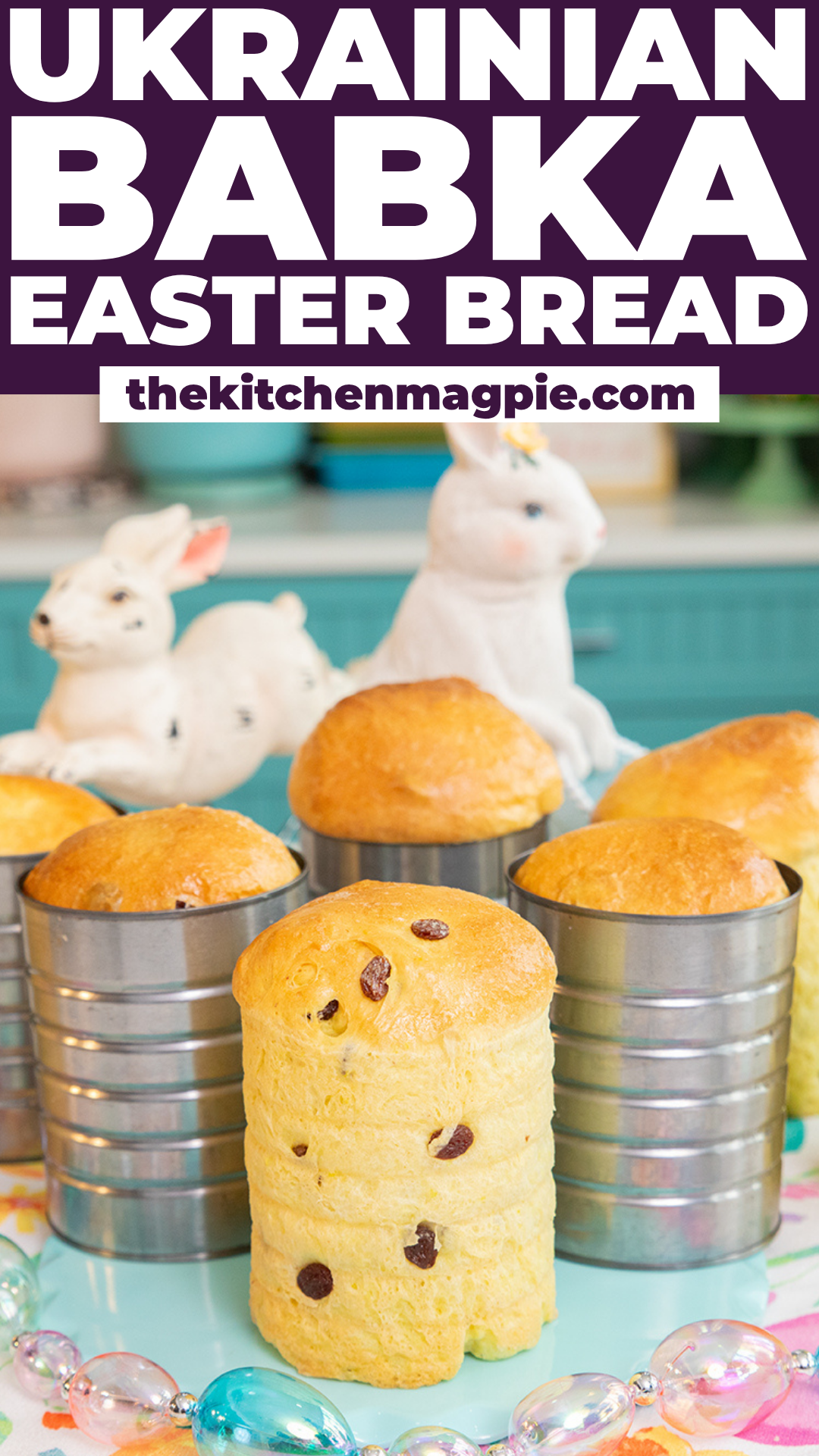
Easter Bread, or Ukrainian Babka, is one of my household’s most beloved Easter traditions. I come from a Ukrainian family, and my grandmothers would make Babka every Easter. When my Grandma wasn’t around to make it, my Mom would take over. I have been making Easter Bread since I had my children and have taught them the tradition.
Karlynn’s Recipe Rundown :
Ukrainian Babka (Easter Bread)
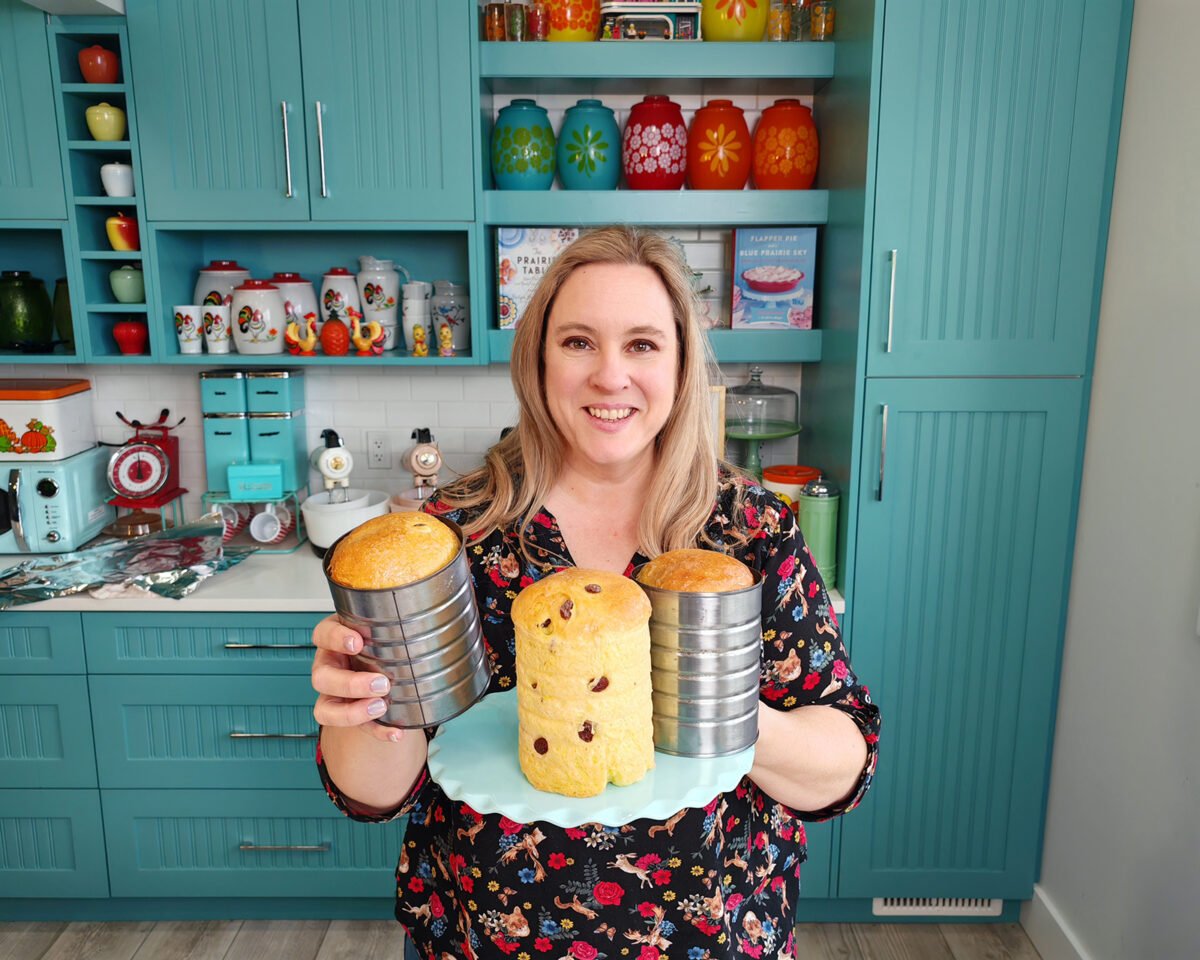
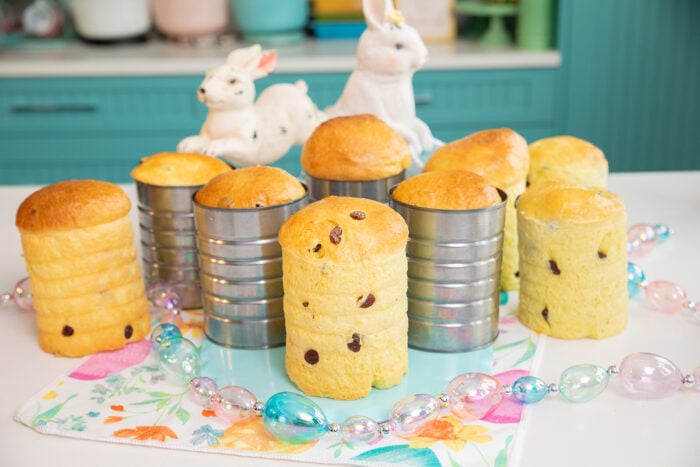
- Babka is a light, buttery, slightly sweet yeast bread with raisins that is traditionally baked in coffee tins. This recipe takes hours to make, so plan accordingly.
- My family has passed down this traditional Ukrainian Babka (Easter bread) recipe for generations. We bake it every Easter.
- This can also be baked in loaf pans if you don’t have a stash of coffee tins.
Is This Babka or Paska?
This recipe is called Babka by mainly Canadian Prairie Ukrainian settlers, as it has been argued (as you can read in the comments!) that this is Paska. Now, here on the Prairies, my Mom and Baba swore up and down that actual Paska is not a sweet bread, is braided, and has no raisins.
Here on the Prairies, we tend to have our own little culture when it comes to being Ukrainians. We pronounce kielbasa as ” koooo-basa” – which is the ONLY place that it’s pronounced like that! Isn’t that strange? It’s a uniquely Canadian prairie version of saying the word; however, with our huge population of Ukrainian settlers, it’s no less authentic, just as calling this Babka is no less authentic. Ways and words were changed when my ancestors arrived here and adapted to a new life.
Ingredient Tips You Need to Know
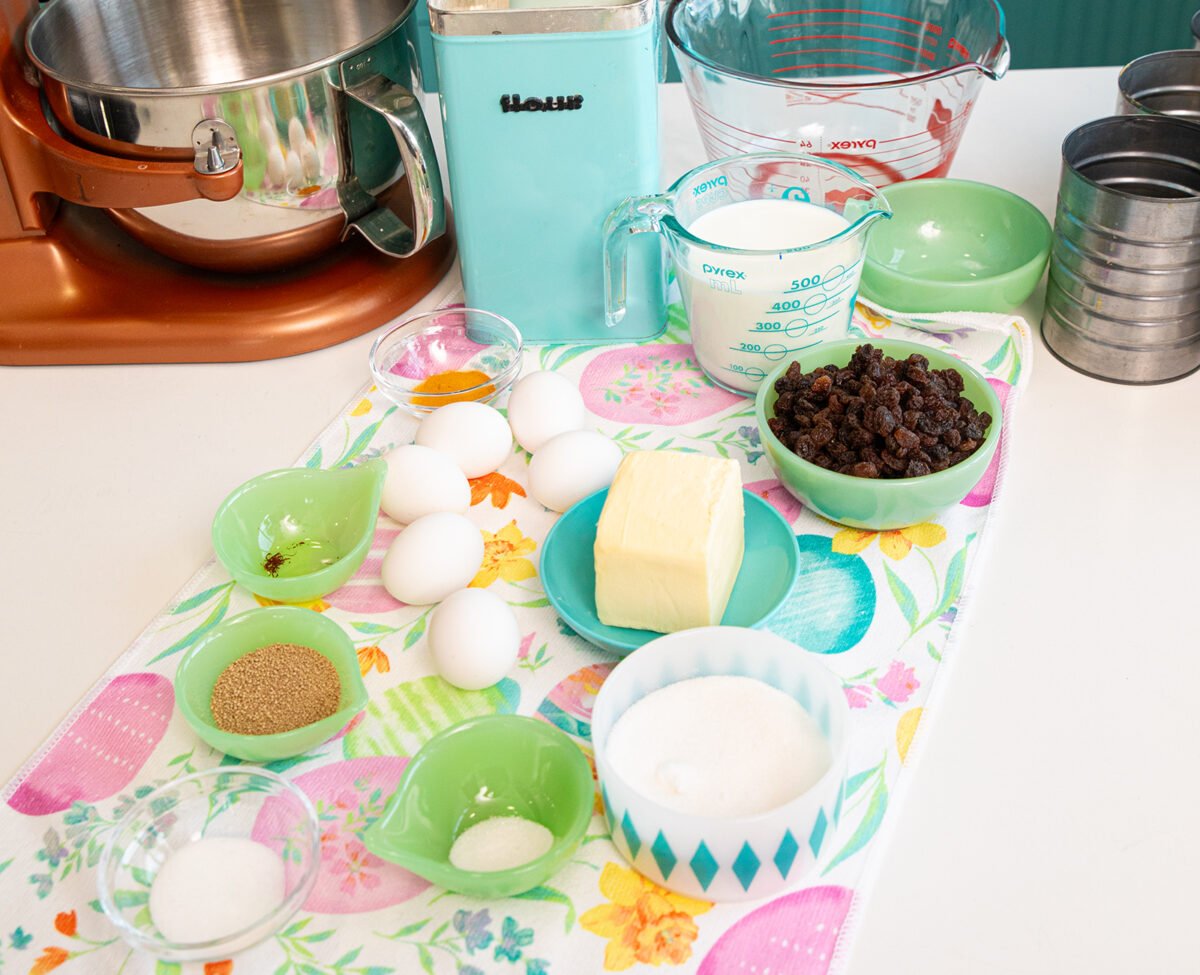
- Butter -the better quality your butter is, the better the babka will taste. If you use salted butter, omit 1 teaspoon of the salt in the recipe.
- Milk: whole milk is the best milk to use in this recipe.
- Granulated Sugar: do not use any other type of sugar in this bread.
- Traditional Yeast: you can only use traditional yeast in this recipe.
- Egg Yolks: using only egg yolks is what makes this bread so rich
- Saffron or Turmeric: saffron is traditional. However, turmeric can be used in a pinch to color the bread.
- All-Purpose Flour – Do not use bread or pastry flour
- Raisins: Thompson raisins are the best in this
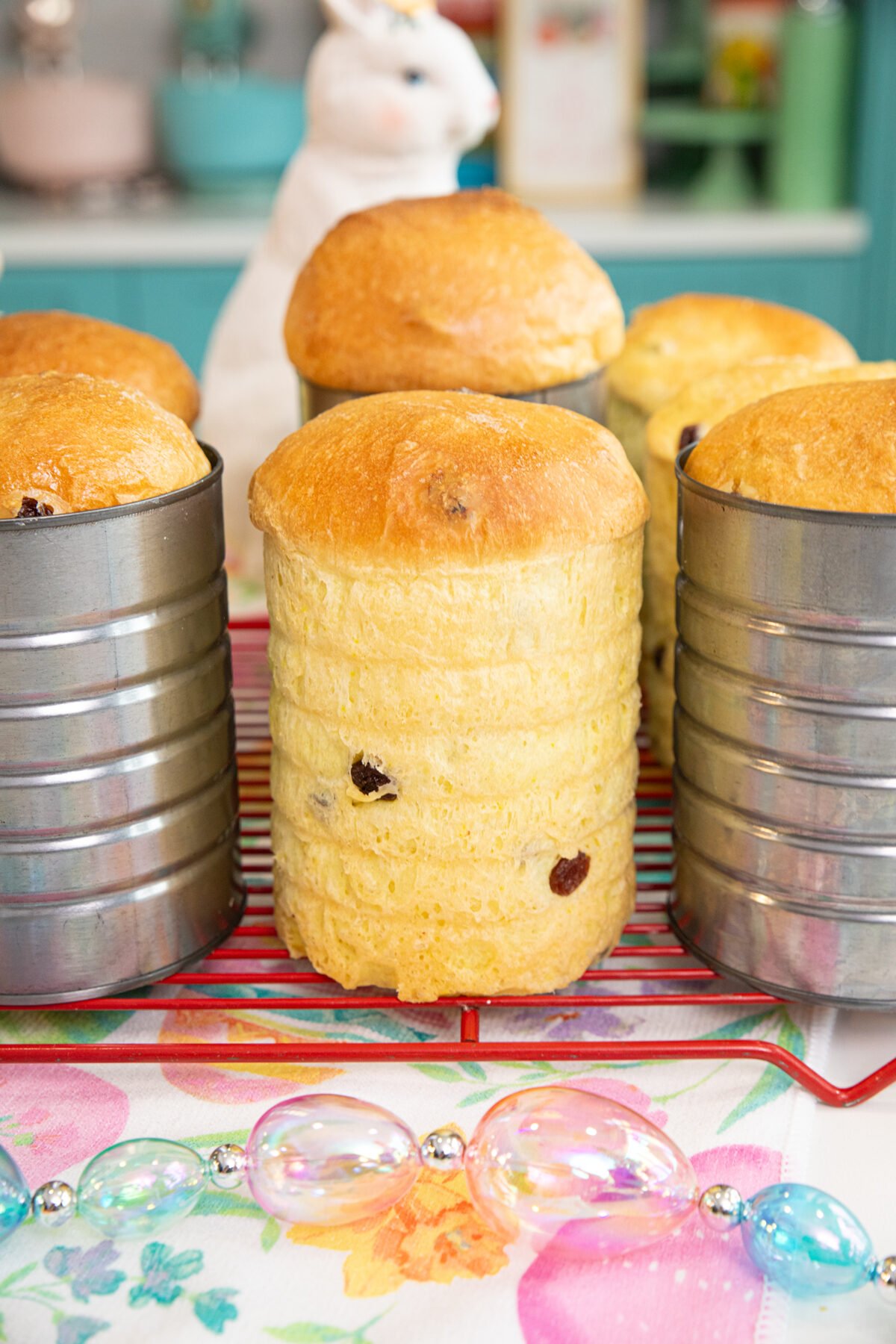

Baba’s Secret to Making the BEST Easter Bread is Scalded Milk
My Grandma’s recipe is different than most for Babka. She was an excellent baker and knew the secret for a fabulous bread: scalded milk!
Scalding milk changes the whey protein in it, making it a better food for yeast. This means that with a yeast-based bread recipe like Babka, you get faster proofing, a larger volume, and lighter, airy bread.
To scald the milk you heat it until it is steaming, but not boiling.
Baking Notes For Success
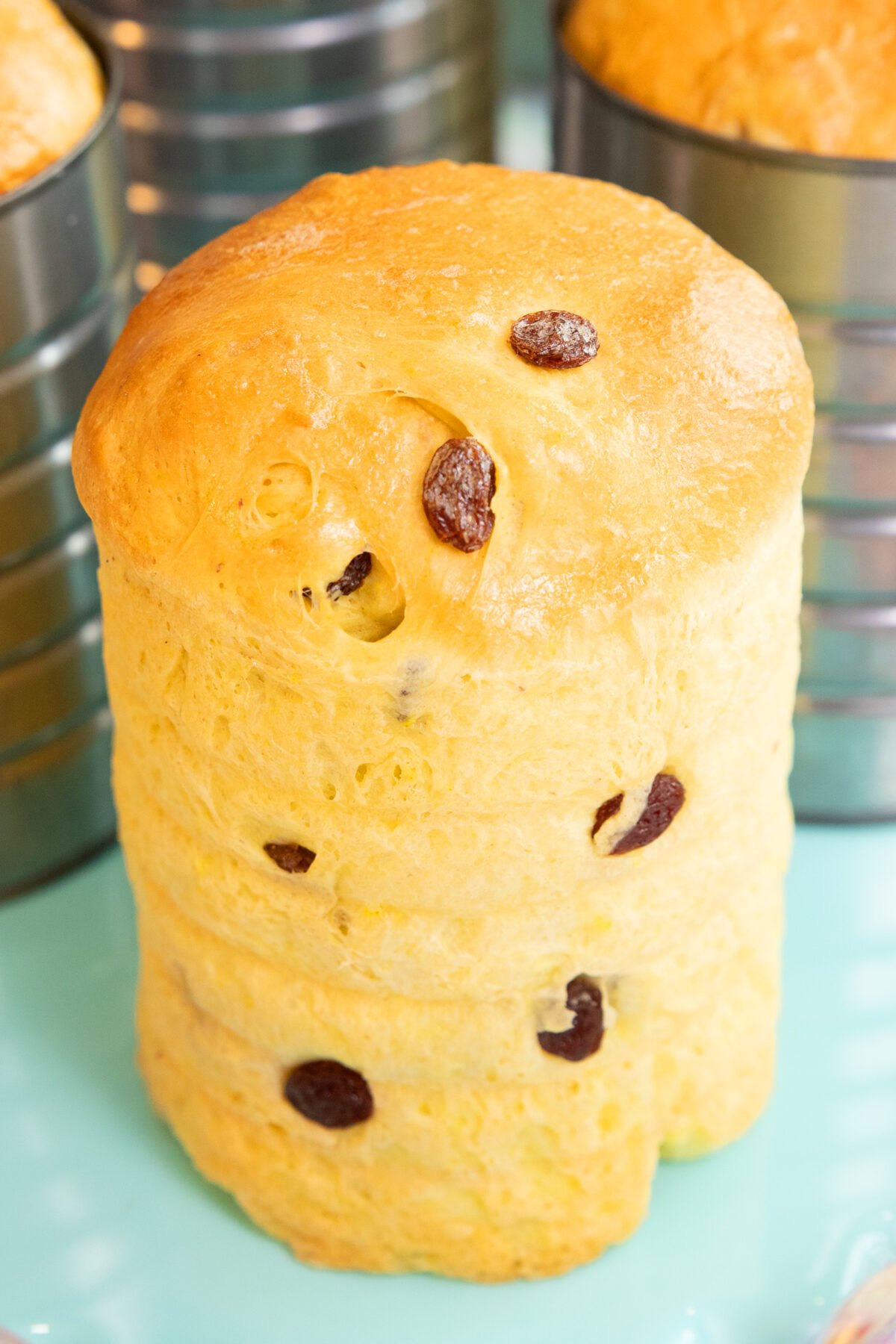
- No matter what size of tin or baking pan you use, the trick for this bread is that you only fill it one-third of the way with the dough. This dough is so light and airy it will triple in size and fill the container. This works in loaf pans and other sizes of coffee or soup tins.
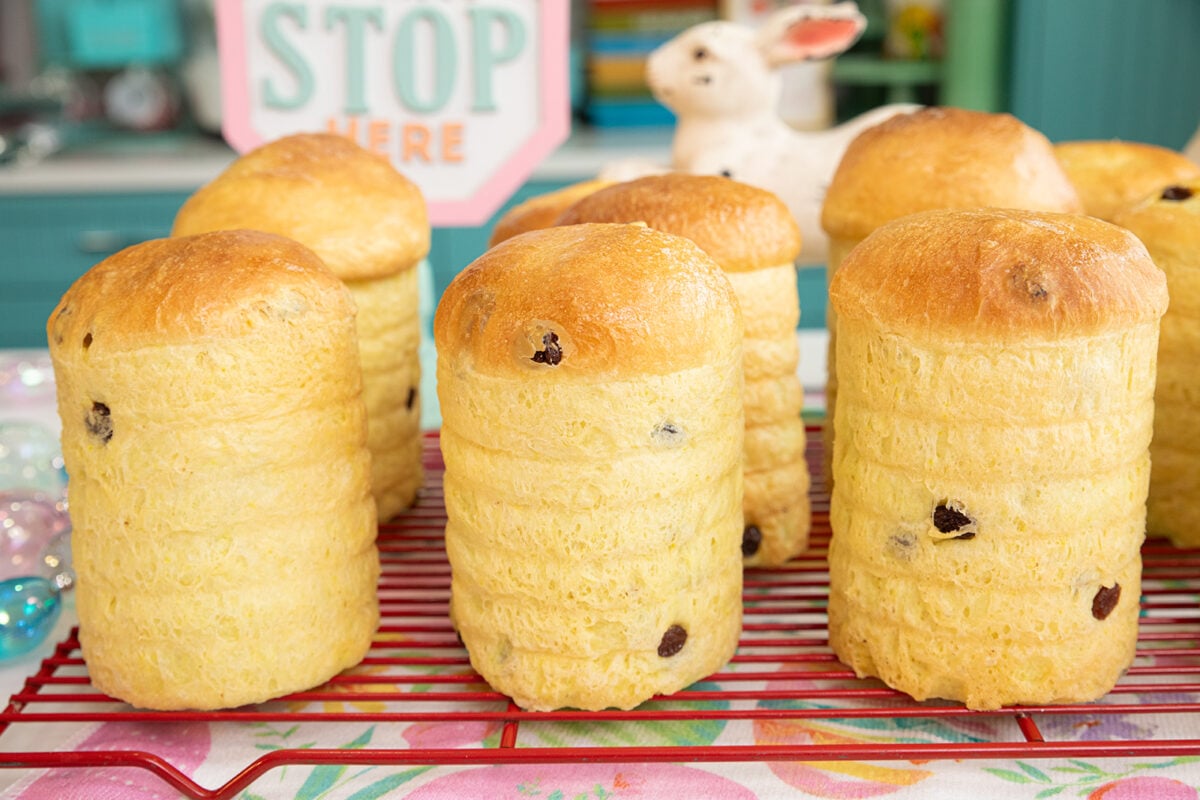
- Generously butter (not spray or anything else) the coffee cans, and your bread will never stick inside. You don’t have to use a knife to release it; simply shake it slightly from side to side, and it will loosen and release.
- You have to remove the Easter bread from the tins 5 minutes after you remove them from the oven. The tins will still be hot, so use oven mitts. If you don’t, the bread will become soggy.
- Watch my long video for help; I go through it step-by-step.
Happy Baking and Happy Easter, you guys! I am so excited to share this recipe with you. It’s our family tradition, and I’m thrilled you can also bake it! Make sure to allot an entire day for baking and watch the full video as well.
Love,
Karlynn
More Delicious Easter Recipes

Easter Bread (Ukrainian Babka)
Video

Equipment
- 10 medium coffee tins
- 5 bread pans
Ingredients
Scalded Milk Mixture
- 1 cup butter, see notes
- 2 cups whole milk
- ¾ cup granulated sugar
- ½ teaspoon saffron, or turmeric
- 6 large egg yolks, beaten – reserve some of the egg white for brushing tops
- 2 teaspoons salt
- 1 cup ice water, ( I add ice)
Yeast Mixture
- ½ cup water, very warm
- 1 teaspoon granulated sugar
- 2 tablespoons traditional yeast
Dry Ingredients
- 8-9 cups all-purpose flour
- 2 cups Thompson raisins
Instructions
Prepare the Scalded Milk Mixture
- Place the butter, whole milk, and ¾ cup of white sugar in a small saucepan. Heat the mixture over medium-high heat until the butter and sugar are dissolved. To scald the milk, continue to heat the mixture until the milk is steaming, then remove from the heat. Do not let it boil. You can also do this in the microwave (my Mom's trick) in a large glass microwave-safe measuring cup.
- Add in the saffron or the turmeric and stir to dissolve. Once the color has leeched from the saffron you can remove the threads if they aren't dissolved.
- Stir in the cup of ice water and let the mixture cool.
- Once cooled, whisk the beaten egg yolks into the mixture. Stir in the salt.
Proof the Yeast
- In the mixing bowl of your stand mixer, place ½ cup of very warm water and 1 teaspoon of granulated sugar. Mix together, then add the yeast. Stir until the yeast starts to dissolve, then let sit until the entire mixture is bubbling.
Make the Dough
- Once the yeast has been proofed, pour the egg mixture into the mixing bowl. Attach your dough hook.
- Add in the first four cups of flour into the mixing bowl, and using the dough hook, mix on low until combined. Add in the raisins next and mix in.
- Add in the next 4 cups of flour, mixing in slowly with the dough hook. Add enough flour until the dough barely sticks to your hands, is pulling away from the sides of the bowl, and is starting to smooth out.
- Knead for another 5 minutes with the dough hook.
- Turn the dough out into a well-oiled large plastic bowl ( the largest Tupperware container is the perfect size for this) and cover with a damp, clean kitchen towel. Place in a warm place for an hour or until the dough has doubled in size.
- Once the dough is ready, punch it down into the bowl and knead it a few times to compress it again. Grease your coffee tins or bread pans thoroughly. Place a dough ball that fills approximately one-third of the coffee can, making sure that the smooth side of the dough ball faces up and any seams are in the bottom of the can. This made ten 300-gram dough balls for my ten coffee tins.
- Remove all the oven racks except the very bottom rack. Place the tins on the rack a couple of inches apart for airflow, and then cover them again with a damp kitchen towel.
- Once the dough has reached the top of the can – around 90 minutes for me sometimes – remove the towel, leave the bread in the oven, and preheat your oven to 325℉.
- For the coffee tins, bake for 25 minutes, placing aluminum foil on top when the tops start to get too brown – they always will after a mere few minutes in the oven. Remove the foil and brush some of the leftover beaten egg white on top of the loaves. Continue to bake for another 10-15 minutes. The bread will sound hollow when tapped and be a dark brown on top when done.
- If they stick slightly in the tins, twist and shake gently at the same time, they will pop right out. If they stick in the loaf pans, run a knife along the edge to free the bread then remove safely.
- Cool on the baking racks completely, then store in airtight containers or bags at room temperature for up to 3 days, or freeze for up to 3 months.
Notes

Nutrition
Nutrition information is automatically calculated, so should only be used as an approximation.

Pin This To Your EASTER BAKING Board, and Remember to FOLLOW ME ON PINTEREST!







Gayle Cilinsky says
This recipe for Babka is very similar to my Mom’s. She always used saffron and added raisins. The only difference is when you remove the babkas out of the tins while they are hot you lay them on tea towel covered pillows to cool, rotating them as they cool. This was necessary because the bread is so delicate.
Edward Bender says
I don’t know. Yet !
First time with. This one.
Lucia says
I’m gluten intolerant, would a GF flour work?
adrienne says
When you say “traditional” yeast, are you referring to fresh yeast? Or active dry yeast?
Thank you!
Mr. Kitchen Magpie says
Active Dry Yeast, thanks for asking.
Maureen D says
This recipe closely resembled my mom’s, and my batch turned out really well. My bread is fluffy and moist! The recipe was easy to follow and brought back good memories! Thank you!
Marlene says
I love this recipe! The bread came out so moist my husband even enjoyed it, and he was indifferent to Easter baba. Probably because my mother’s, as she aged, was very dry. From this one recipe I made a large loaf in an angel food cake pan and two regular bread loaf pans. This is definitely a keeper.
Shelley says
Are you saying to leave the tins in the oven while preheating? So essentially the tins “preheat” as well? As a side note, I grew up in Winnipeg and my Ukrainian family, we all called it Paska. Funny, different from region to region.
Angie says
I have the same recipe & have used it for about 30years. I have , in that time made a few changes, I use parchment paper in the cans, & cut them about an inch taller than the cans. I am much easier when baking, cuz I know the bread will come out without sticking. I also use instant yeast. But the recipe remains the same. It makes the most delicious bread.
Dave says
For years I have been making this with an old recipe, that called for cents worth of saffron.
My grandmother and mother always used tomatoe juice cans to bake it in .
Her recipe also made enough for 30 loaves as it would be shared.
It was an all day process to bake that much bread
Shawn says
Hi Karlynn, my mom’s mom came from Ukraine early, landed in the Lakehead/ Fort William / Thunder Bay. Grandma’s brother-in-law was a baker. our family has always called the Easter bread Babka, perogies are Pet-a-ha. They always used saffron if they could. Thank you for this authentic recipe.
Cathy says
Shawn,
My Baba came from the Ukraine and settled in Fort William as well.
I have been looking for instructions as Baba is long gone and nobody knows how to make this . Put a hair and Saffron Baba Bread..
Small world
Kerilee Snatenchuk says
Thanks for this recipe. I have made it twice and both times used my wild sourdough yeast and it turns out great every time. My mother recently passed and I was looking to keep our Ukrainian Easter traditions going. I found your recipe – she would be proud to see the babka tradition keep going.
Melissa Dutka says
I am from NY, my grandparents came here via Germany post war… being from Ukraine my grandparents never lived in Canada but we called babka babka and also perogi we’re called ( pid-o-hay-a ) I can only spell it how it sounds but most people do not call it that … and Kabashi is kebasa… bothe grandparents were from northern Ukraine
Jacqueline Kennedy-Green says
Can you tell me the actual size of these coffee runs when they’re filled with coffee? Lol I don’t drink coffee so I’m not familiar. Thank you!
Stephana BobeyPoulsen says
Haha! Love your intro…those are exactly all the words I was using to describe other websites as I searched for a recipe closest to what I remember making with my grandma in Edmonton.
Linda says
Sheepishly but very respectfully I’d like to ask can I make babka dough using the dough cycle in my bread machine and then transfer it to a loaf pan to bake it in my oven?
Erica says
The recipie was very easy to follow and tasty. We found the next day it was dry and not moist. Any suggestions why that could be? Thanks
Stacey says
Thanks for the recipe! I have been searching for this specific bread as I grew up with it but as Baba’s passed, the recipes faded away. We must be pretty close to same Ukrainian communities, this is Easter bread and it’s koobasa 🙂
PAULETTE SCHENK says
What I do is make One batch with tumeric and one without, I divide all into a marble yellow and white color bread. this is what my Baba (Grandmother) would do, the closest recipe I could find. I’ve been using this for a few years now. Love it!
she never had a recipe so this was gold to me .
Thank You
Ali says
My babusia who settled in Wisconsin also called this bread Babka, never Paska. And she and my mom also always said “koo-basa” for sausage. And dumplings were always perohy (pronounced “peh-roh-hih”… i have never heard anyone pronounce or read that as ‘parahah’). She was from the part of Ukraine that was part of Galicia
Andrea Knox (Bodniowycz) says
Same with us! Babka and “ koobasa”
Angela from Calgary says
I love this recipe. I made it for the first time two days ago. I used saffron, since that’s what I grew up with. It’s easy to follow, and the bread turned out absolutely delicious. I halved the recipe so I was able to do all the kneading with a Kitchen Aid mixer.
You are right, it rises like crazy !!
Thank you for sharing your family recipe !!
Iris says
Hi Angela
Help!!!Never used saffron before, do u soak it in water and use the liquid or do u actually put the saffron herb in?
Larry Komoski says
We make a “saffron tea” in a shotglass. A pinch of Saffron with hot water. let it seep for 10 minutes. Strain the Saffron out and add the cooled liquid to your wet ingredients.
Val Tworek says
A bit to much turmeric, too yellow for me, maybe just a 1/4 tsp next time .But otherwise great and easy ! 😊
Christine says
Delicious! I made one into a chocolate babka too and dang it’s good!
Kathie Yates says
How long do you bake the loaf pans for? Is it the same as the cans?
Debbie says
Karlynn, do your coffee tins have a rim ?
Did you inherit coffee tins without a rim ?
Or, if you grease your tins enough, even with a rim, the Paska will rise ?
Susan says
Sooooo disappointed in this recipe. I tried it 2x…never came close to rising as it should not during 1st rising nor second, and not when I tried it the next day. Yeast wss brand new…all ingredients fresh. Rising environment perfect temp. This recipe flopped for my friend, too.
Veronica says
Yes, it should be made with saffron instead of turmeric! I suppose if you can’t find saffron, turmeric will do.
Bianca says
You can use a can opener to easily remove the rims on coffee cans. I wouldn’t try it with a rim!
Kate Pigula says
Karlynn.I’m not sure about the spelling but being full blood Ukrainian ,I thought the correct way to pronounce for Ukrainian is pirohy (rolling the r). The Polish was is pirogi. Either way they are delishes.
Irene says
Pronunciation in the western provinces has changed over the many years of Ukrainian settlement, but as a Ukrainian Canadian, born in Germany and brought to Ontario in 1948, fluent in the Ukrainian language (also read and write it), I can vouch for the fact that “perohy” is pronounced as “pirohi” and not “paraha”. This name was used for these dumplings in the western Ukraine (which bordered on Poland) and came from the Polish “pierogi” pronounced “Pee-ye-rogi). The rest of Ukraine knew them as “varenyky” (vareniki), while perohy or “perishki” (small perohy) were actually baked buns with savoury fillings (eg. sauerkraut and mushrooms, meat fillings etc.)
Ali says
Thank you for this. I have never in my /life/ heard “paraha”
Sandra Seneshen says
We share your family’s division of Babka, and Paska. Having done a bit of research to supplement the family stories( my grandfather was 5 when they emigrated, and the great grandparents were long gone before I was born), I think the language differences are because the great pre WW1 Ukrainian immigration to the Canadian Prairies was largely from the portion of Western Ukraine held by the Austro-Hungarian empire, and consequently those languages get muddled in. This is why Ukrainians were considered ‘enemy aliens’ during the Great War, and had to have special papers to leave their homes,;or risk internment in camps, despite, in fact, being refugees from the enemy territory.
Cindy says
Thank you for your lovely story and recipe. My mom and her family are from the Canadian prairies. And her parents immigrated at different times between 1900-1920 and from different parts of Europe. Lots of families members got lost travelling out of Europe to find passage to the new country. So new traditions were
Born. This bread with raisins is one of my mom’s fav tradition for Easter. She has told the stories of why they changed the recipes and added different ingredients to like raisins in the Easter bread to make up for the shortages in other foods that were traditional in the old country. Her perogies were just as different too. I miss the big family meals where everyone brought their fav dish. We lost our recipes a few years ago and I will be making your Easter bread this year .
Sandra Moroz says
Hi Lorraine: Perogy is actually Polish. Perohy (paraha) is the correct way to pronounce this in Ukrainian. Varenyky is another word that is also used. There is nothing wrong with your pronounciation. Try saying perohy to a Ukrainian person, you will not be disappointed. Keep up your Ukrainian cooking!! …….Sandra Moroz Moncton, N.B.
Deb says
My grandmother was Ukrainian and we also used Varenyky
Olya says
I can’t find traditional yeast so can I use sourdough starter instead ?
Jackie says
I don’t want to make such a big recipe can I shorten it somehow.
Alexina says
I cut it in half ! Worked great 🙂
Bobbie says
So great! Each step was clear & precise. It made perfect dough that was easy to work with. Thank you!
JOYCE says
How many loaf pans would I need for this recipe? I don’ have coffee tins.
Ruby says
Yippee!! I’m thrilled to see that you put Saffron in your Babka – like my Baba! AND . . . she always made her Babka in Tomato Juice Cans – looked like the coffee tins you have used for some. Well done!!! Now all I have to do is make some!! Fingers crossed that it will live up to the memory I have of how hers tasted.
Lorraine A Murdoch says
I can’t wait to try this. I grew up in Manitoba and we called perogies, paraha. People definitely look at me strange when I say that…lol
Sandra Moroz says
Hi Lorraine: Perogy is actually Polish. Perohy (paraha) is the correct way to pronounce this in Ukrainian. Varenyky is another word that is also used. There is nothing wrong with your pronounciation. Try saying perohy to a Ukrainian person, you will not be disappointed. Keep up your Ukrainian cooking!! …….Sandra Moroz Moncton, N.B.
Kate Pigula says
Sandra I just noticed your comment. I wrote the same thing as you. Pirohy for Ukrainian. You are absolutely right.