This post may contain affiliate links. Please read our privacy policy for additional information.
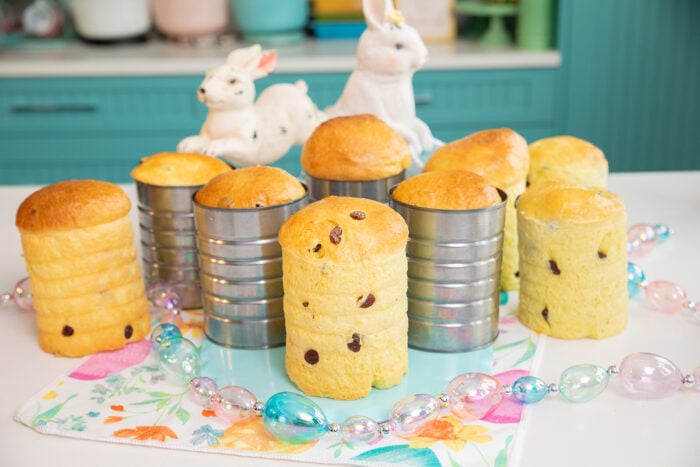
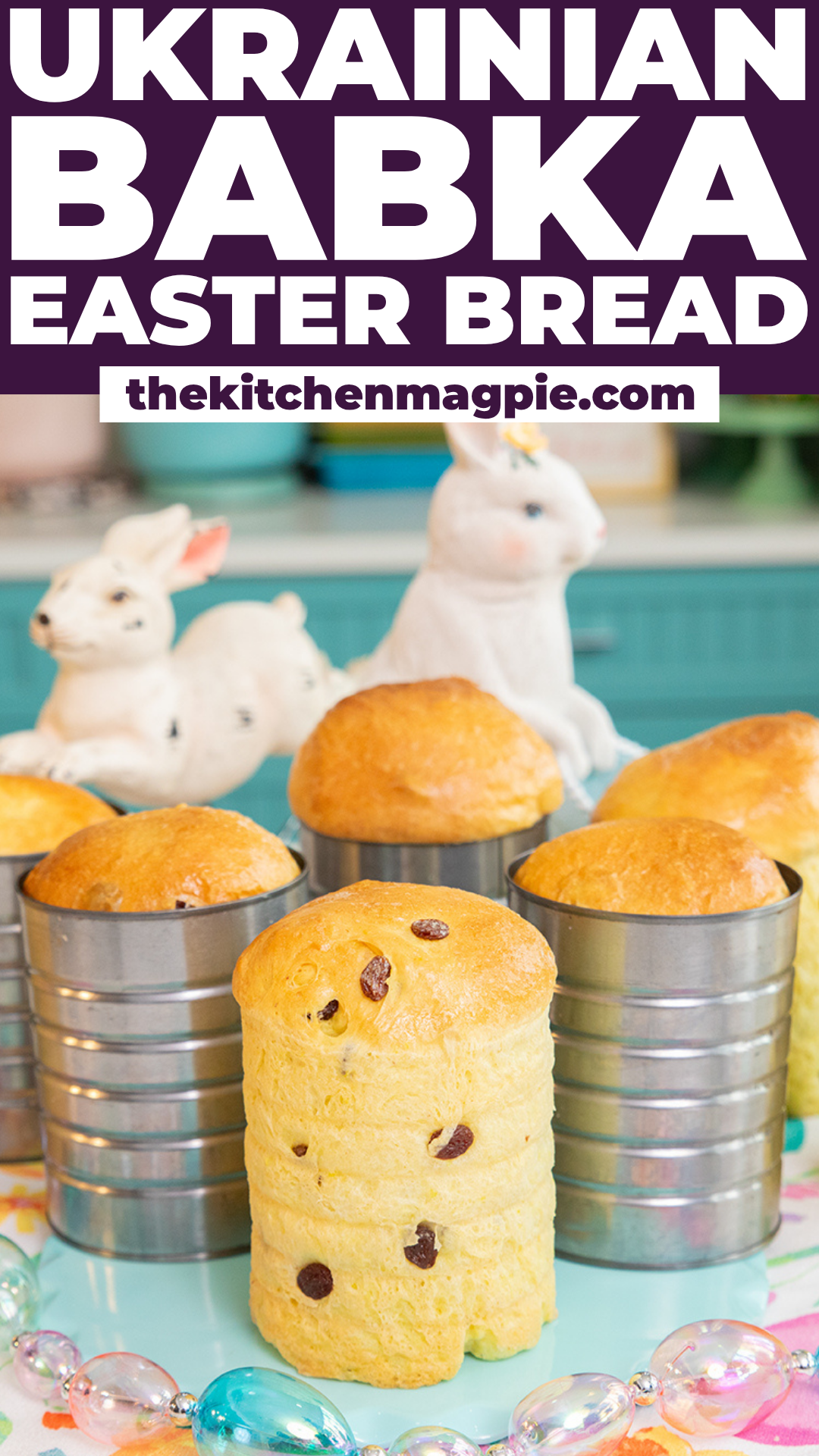
Easter Bread, or Ukrainian Babka, is one of my household’s most beloved Easter traditions. I come from a Ukrainian family, and my grandmothers would make Babka every Easter. When my Grandma wasn’t around to make it, my Mom would take over. I have been making Easter Bread since I had my children and have taught them the tradition.
Karlynn’s Recipe Rundown :
Ukrainian Babka (Easter Bread)
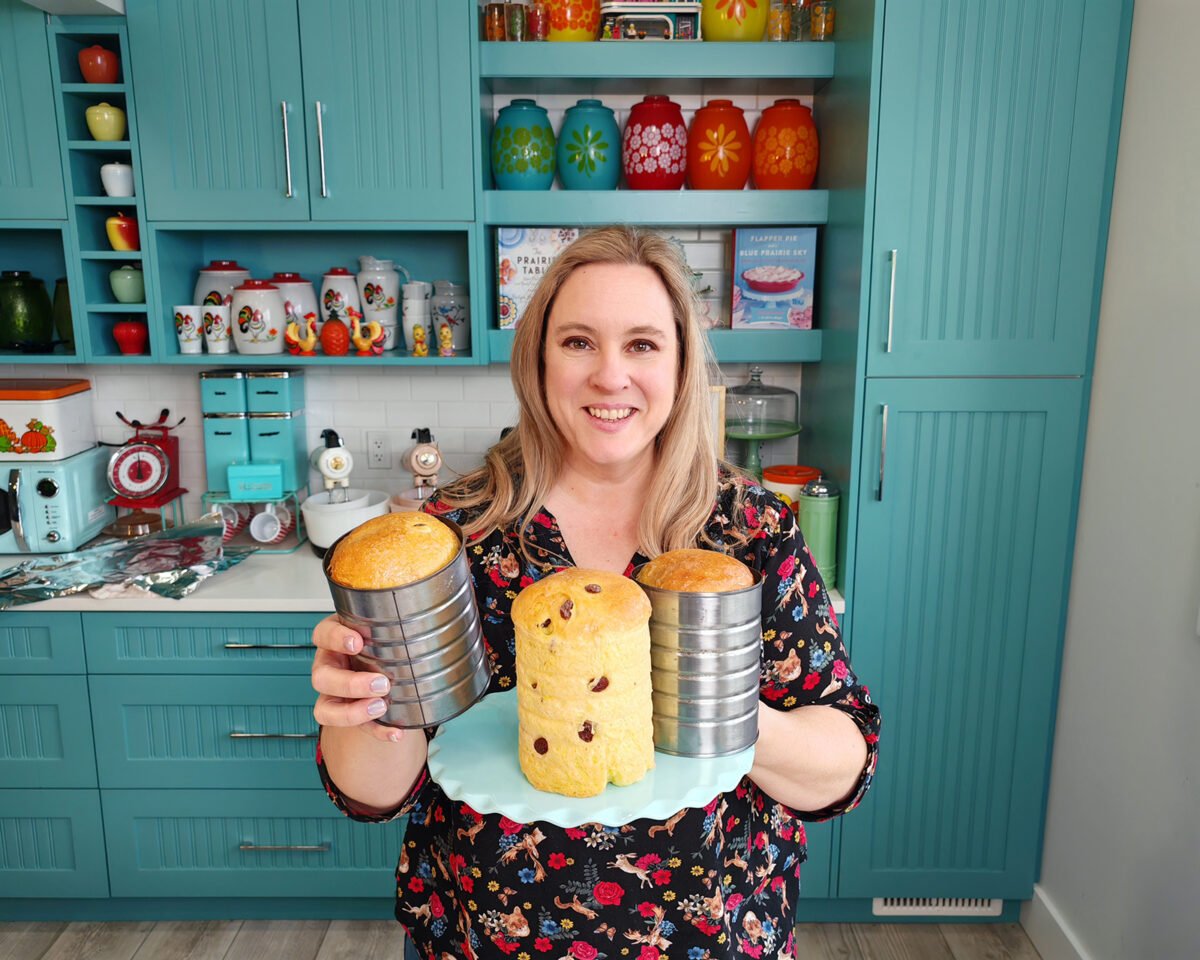
- Babka is a light, buttery, slightly sweet yeast bread with raisins that is traditionally baked in coffee tins. This recipe takes hours to make, so plan accordingly.
- My family has passed down this traditional Ukrainian Babka (Easter bread) recipe for generations. We bake it every Easter.
- This can also be baked in loaf pans if you don’t have a stash of coffee tins.
Is This Babka or Paska?
This recipe is called Babka by mainly Canadian Prairie Ukrainian settlers, as it has been argued (as you can read in the comments!) that this is Paska. Now, here on the Prairies, my Mom and Baba swore up and down that actual Paska is not a sweet bread, is braided, and has no raisins.
Here on the Prairies, we tend to have our own little culture when it comes to being Ukrainians. We pronounce kielbasa as ” koooo-basa” – which is the ONLY place that it’s pronounced like that! Isn’t that strange? It’s a uniquely Canadian prairie version of saying the word; however, with our huge population of Ukrainian settlers, it’s no less authentic, just as calling this Babka is no less authentic. Ways and words were changed when my ancestors arrived here and adapted to a new life.
Ingredient Tips You Need to Know
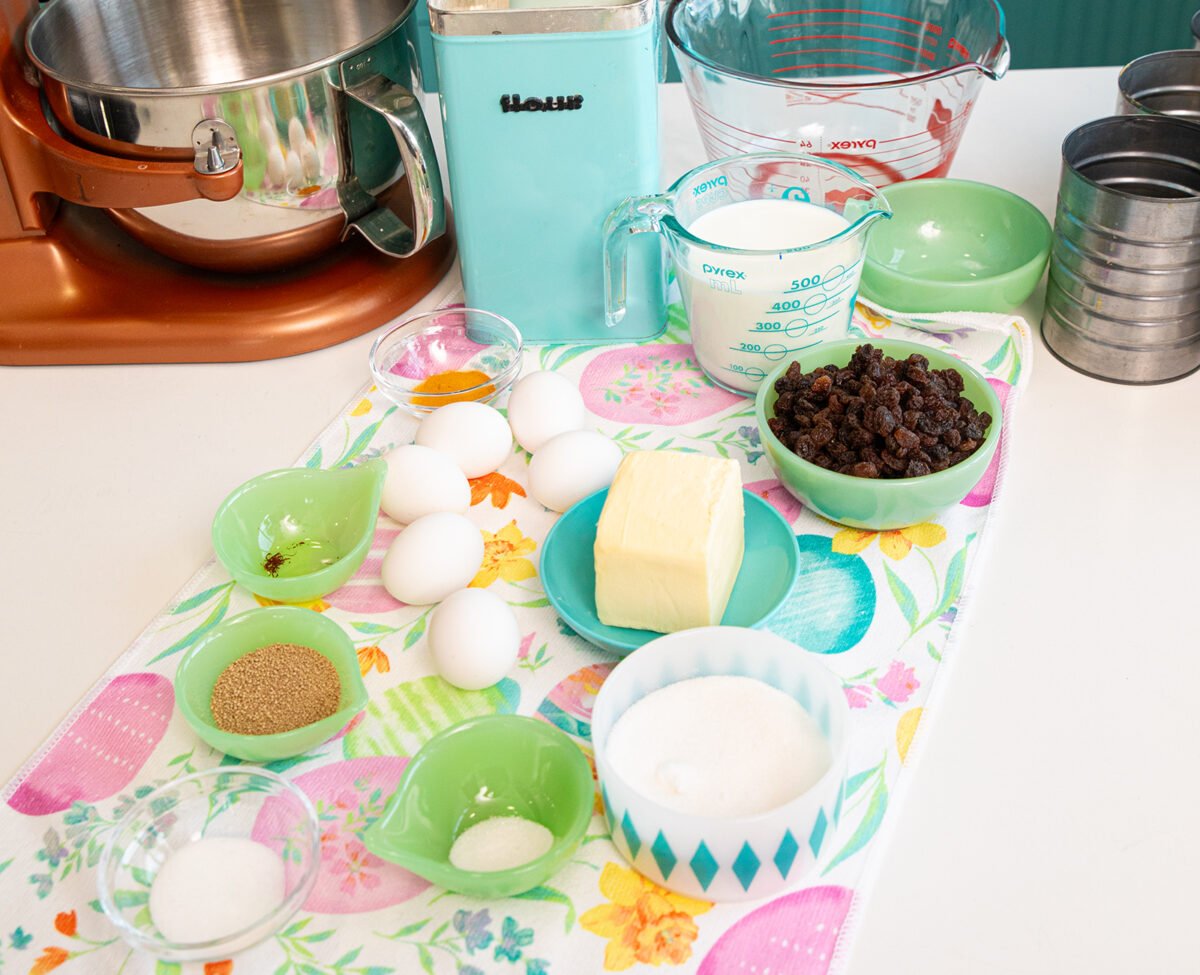
- Butter -the better quality your butter is, the better the babka will taste. If you use salted butter, omit 1 teaspoon of the salt in the recipe.
- Milk: whole milk is the best milk to use in this recipe.
- Granulated Sugar: do not use any other type of sugar in this bread.
- Traditional Yeast: you can only use traditional yeast in this recipe.
- Egg Yolks: using only egg yolks is what makes this bread so rich
- Saffron or Turmeric: saffron is traditional. However, turmeric can be used in a pinch to color the bread.
- All-Purpose Flour – Do not use bread or pastry flour
- Raisins: Thompson raisins are the best in this
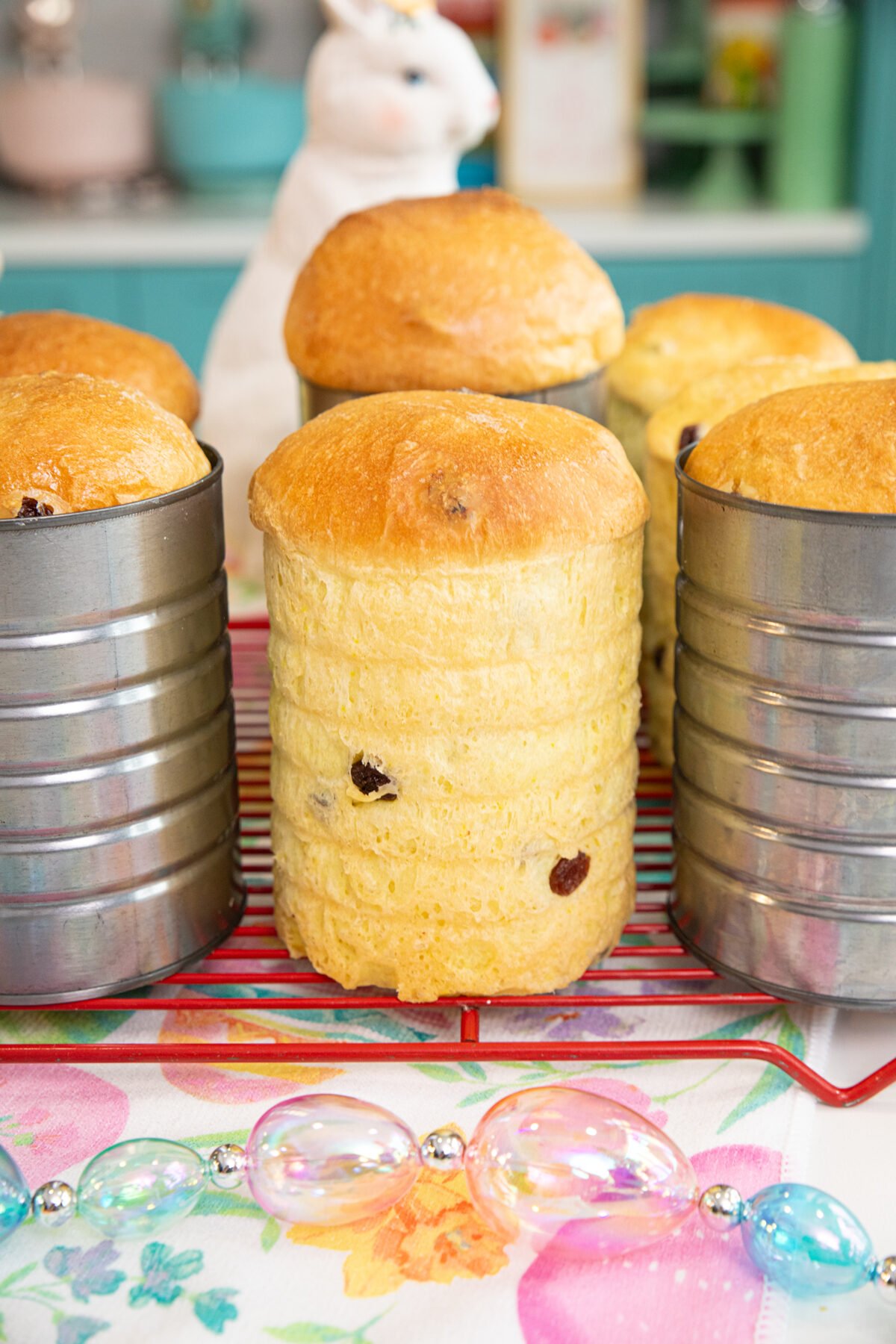

Baba’s Secret to Making the BEST Easter Bread is Scalded Milk
My Grandma’s recipe is different than most for Babka. She was an excellent baker and knew the secret for a fabulous bread: scalded milk!
Scalding milk changes the whey protein in it, making it a better food for yeast. This means that with a yeast-based bread recipe like Babka, you get faster proofing, a larger volume, and lighter, airy bread.
To scald the milk you heat it until it is steaming, but not boiling.
Baking Notes For Success
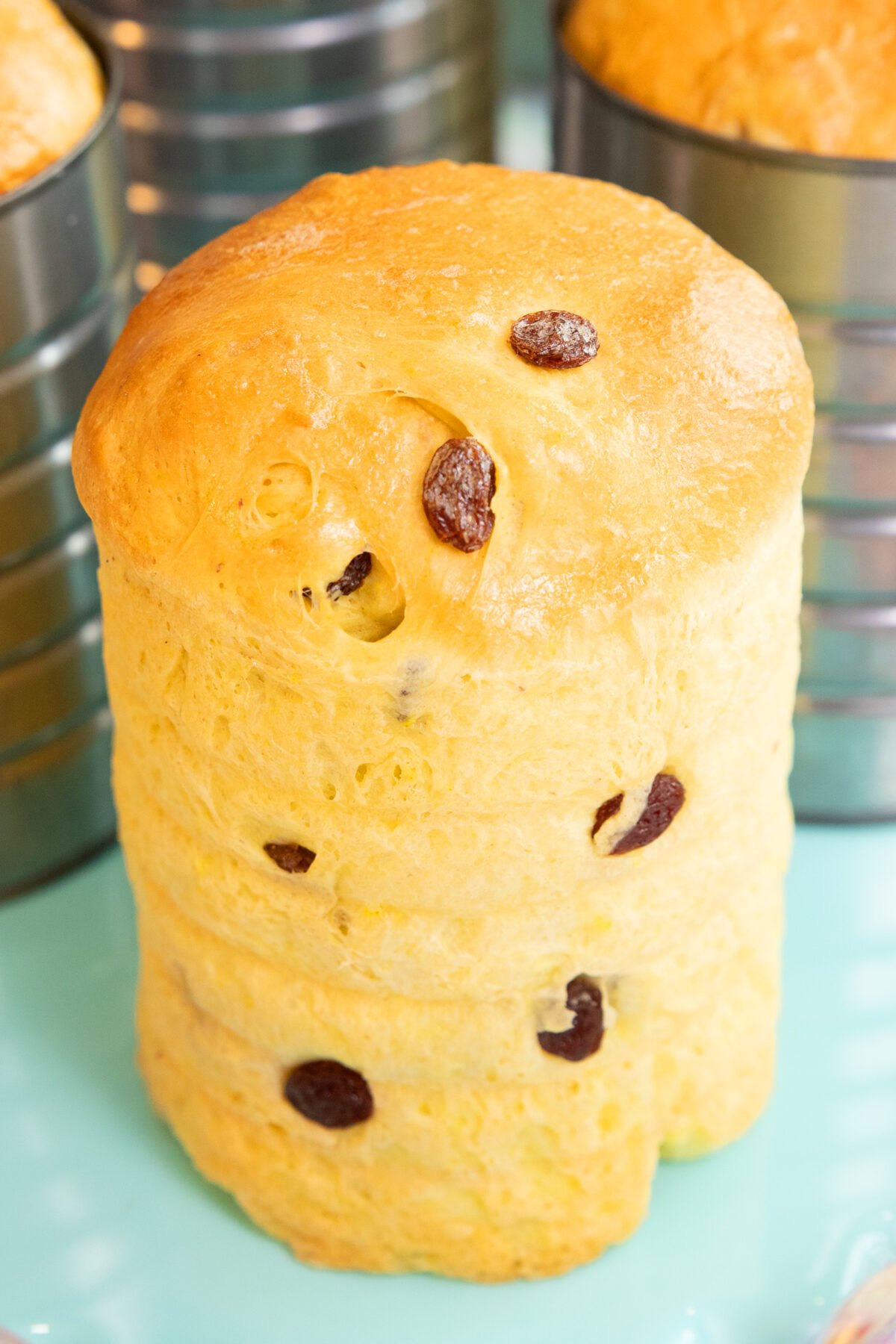
- No matter what size of tin or baking pan you use, the trick for this bread is that you only fill it one-third of the way with the dough. This dough is so light and airy it will triple in size and fill the container. This works in loaf pans and other sizes of coffee or soup tins.
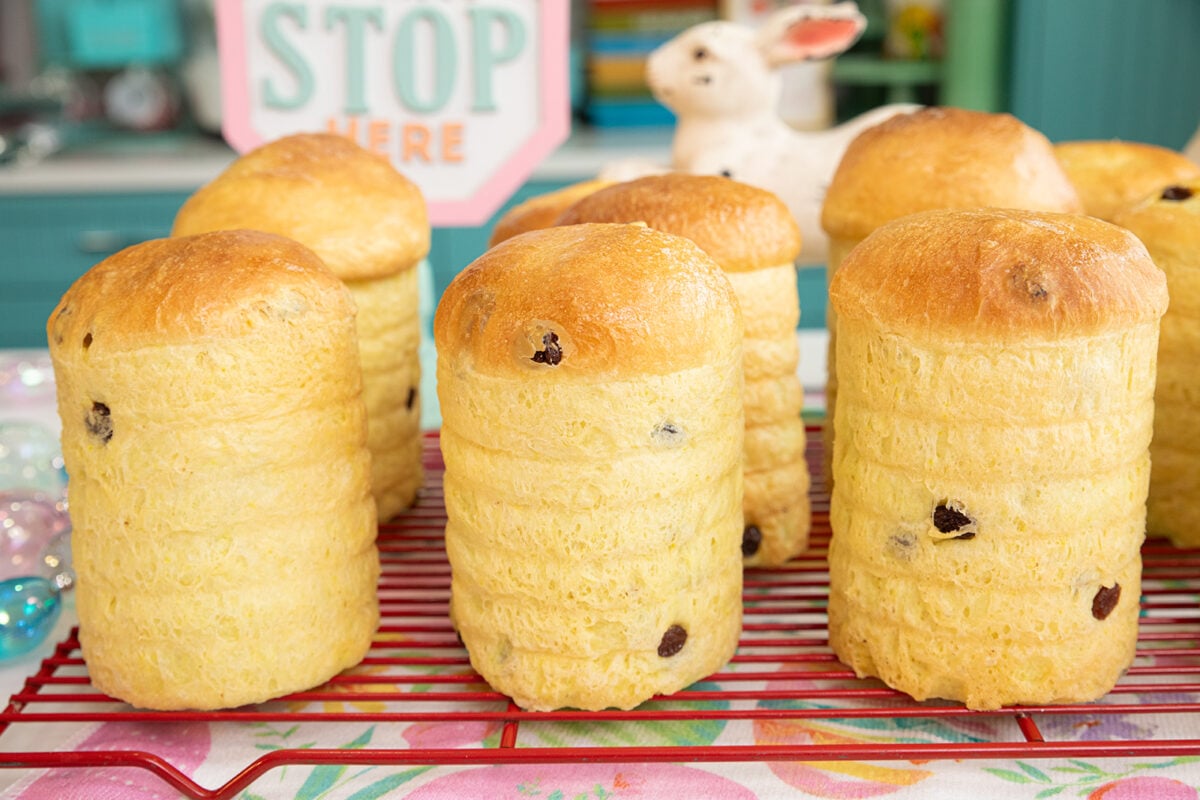
- Generously butter (not spray or anything else) the coffee cans, and your bread will never stick inside. You don’t have to use a knife to release it; simply shake it slightly from side to side, and it will loosen and release.
- You have to remove the Easter bread from the tins 5 minutes after you remove them from the oven. The tins will still be hot, so use oven mitts. If you don’t, the bread will become soggy.
- Watch my long video for help; I go through it step-by-step.
Happy Baking and Happy Easter, you guys! I am so excited to share this recipe with you. It’s our family tradition, and I’m thrilled you can also bake it! Make sure to allot an entire day for baking and watch the full video as well.
Love,
Karlynn
More Delicious Easter Recipes

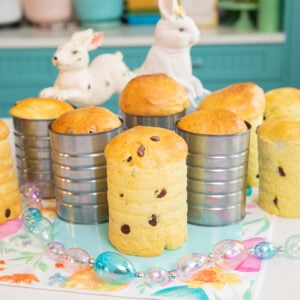
Easter Bread (Ukrainian Babka)
Video

Equipment
- 10 medium coffee tins
- 5 bread pans
Ingredients
Scalded Milk Mixture
- 1 cup butter, see notes
- 2 cups whole milk
- ¾ cup granulated sugar
- ½ teaspoon saffron, or turmeric
- 6 large egg yolks, beaten – reserve some of the egg white for brushing tops
- 2 teaspoons salt
- 1 cup ice water, ( I add ice)
Yeast Mixture
- ½ cup water, very warm
- 1 teaspoon granulated sugar
- 2 tablespoons traditional yeast
Dry Ingredients
- 8-9 cups all-purpose flour
- 2 cups Thompson raisins
Instructions
Prepare the Scalded Milk Mixture
- Place the butter, whole milk, and ¾ cup of white sugar in a small saucepan. Heat the mixture over medium-high heat until the butter and sugar are dissolved. To scald the milk, continue to heat the mixture until the milk is steaming, then remove from the heat. Do not let it boil. You can also do this in the microwave (my Mom's trick) in a large glass microwave-safe measuring cup.
- Add in the saffron or the turmeric and stir to dissolve. Once the color has leeched from the saffron you can remove the threads if they aren't dissolved.
- Stir in the cup of ice water and let the mixture cool.
- Once cooled, whisk the beaten egg yolks into the mixture. Stir in the salt.
Proof the Yeast
- In the mixing bowl of your stand mixer, place ½ cup of very warm water and 1 teaspoon of granulated sugar. Mix together, then add the yeast. Stir until the yeast starts to dissolve, then let sit until the entire mixture is bubbling.
Make the Dough
- Once the yeast has been proofed, pour the egg mixture into the mixing bowl. Attach your dough hook.
- Add in the first four cups of flour into the mixing bowl, and using the dough hook, mix on low until combined. Add in the raisins next and mix in.
- Add in the next 4 cups of flour, mixing in slowly with the dough hook. Add enough flour until the dough barely sticks to your hands, is pulling away from the sides of the bowl, and is starting to smooth out.
- Knead for another 5 minutes with the dough hook.
- Turn the dough out into a well-oiled large plastic bowl ( the largest Tupperware container is the perfect size for this) and cover with a damp, clean kitchen towel. Place in a warm place for an hour or until the dough has doubled in size.
- Once the dough is ready, punch it down into the bowl and knead it a few times to compress it again. Grease your coffee tins or bread pans thoroughly. Place a dough ball that fills approximately one-third of the coffee can, making sure that the smooth side of the dough ball faces up and any seams are in the bottom of the can. This made ten 300-gram dough balls for my ten coffee tins.
- Remove all the oven racks except the very bottom rack. Place the tins on the rack a couple of inches apart for airflow, and then cover them again with a damp kitchen towel.
- Once the dough has reached the top of the can – around 90 minutes for me sometimes – remove the towel, leave the bread in the oven, and preheat your oven to 325℉.
- For the coffee tins, bake for 25 minutes, placing aluminum foil on top when the tops start to get too brown – they always will after a mere few minutes in the oven. Remove the foil and brush some of the leftover beaten egg white on top of the loaves. Continue to bake for another 10-15 minutes. The bread will sound hollow when tapped and be a dark brown on top when done.
- If they stick slightly in the tins, twist and shake gently at the same time, they will pop right out. If they stick in the loaf pans, run a knife along the edge to free the bread then remove safely.
- Cool on the baking racks completely, then store in airtight containers or bags at room temperature for up to 3 days, or freeze for up to 3 months.
Notes

Nutrition
Nutrition information is automatically calculated, so should only be used as an approximation.

Pin This To Your EASTER BAKING Board, and Remember to FOLLOW ME ON PINTEREST!







Tama'ra J Lawrence-Olenczuk says
Looks gross
Sandy Omland says
\U0001f430\U0001f430\U0001f430 \U0001f44d
wyliekinson says
Great recipe – very similar to my mom’s Babka (she’s from the Ukraine). I’ve helped her make it in the past, but this is the first year I’ll be doing it on my own. She doesn’t use turmeric, however. We always use saffron to give it the color. Happy Easter!
Amy says
Thanks for the recipe! I inherited a recipe (labeled “Easter bread” or “paska”) from my husband’s family. I’ve always had trouble with the dough being ridiculously sticky, so I thought I’d try a different recipe this year. Even once I’ve added in the full amount of flour, the dough is still closer to batter than to bread dough. Last night I added probably an additional 2 cups of flour by the time I was done. From your experience, is this likely an issue of needing additional time for kneading (needing kneading – ha!) or the need for more flour?
My loaves are in the oven now – can’t wait to taste them because they smell delicious 🙂
Amy says
Thanks for the recipe! I inherited a recipe (labeled “Easter bread” or “paska”) from my husband’s family.
Lexkelmo says
i used this recipe last year in place of our ”family” recipe for Babka and was so happy with the results. I made it again today and I am just as happy! Wonderful dough and it kneads so well in my 6 Qt. Kitchen Aid. Rise is fantastic and the texture is amazing. Thank you for a wonderful old world recipe.
thekitchenmagpie says
Lexkelmo SO glad that you liked it! We ate it for breakfast this morning …and will eat it tomorrow… and the day after..make sure to check out my Babka Monkey Bread recipe on here as well, it’s the best thanks to this dough! Happy Easter!
Annie says
Perfect! I have been making babka my whole life with my mom, show passed away last year and this was my first solo attempt. I had the cans ( also used a pampered chef crock, comes out nice). The recipe was easy to follow . The only problem I always have is how much to put in the can! I found a half a can is a bit too much! I’ll post by breads on fb. Thank you so much and XB, God Bless and happy Easter!
thekitchenmagpie says
@Annie Glad it worked out! Yes, it can be tricky figuring out how much dough, it can rise like crazy! Maybe a “scant” half would be more like it…a third might be too little… Happy Easter to you as well! Have a fabulous weekend!
MarianneG says
My grandmother was straight from Ukraine and this recipe is for paska, which is Ukrainian Easter bread. Paska is a sweet, rich yellow bread reserved for Easter, typically with yellow raisins, though it can be made without the raisins if you prefer. Babka is much sweeter, more of a desert and may have more variety of ingredients, and usually a sweet topping like a frosting. Paska is the bread you have described and it is reserved only for Easter, while babka is more a desert, and is certainly served at Easter, but unless I am mistaken, is not reserved specifically for Easter, because I remember the Ukrainian bakery in the Ukrainian neighborhood where my grandparents and aunts lived and where my mom grew up made babka year round, but not paska. Paska is what you would refer to as Ukrainian Easter bread, not babka, though babka is awesome, too. Paska would traditionally put in Easter baskets and taken to church to be blessed, though a lot of the Ukrainians also took a small babka to church in their baskets in addition to their paska. My Ukrainian grandma made and taught my mom and aunts to make paska, and I too have eaten paska year after year, have watched my grandmother, aunts and mom make it over and over through the years, and have helped to make it countless times, but have never attempted it myself. I remember what was done, but I wish I had their exact recipe! So this year I have made a commitment to DO IT! I’m comparing paska recipes now. This one and some others I have found seem to capture the ingredients and techniques I remember. I am going to experiment with a couple recipes. I attended only Ukrainian church until I was in 8th grade when we moved across the country, and I remember my grandma and the other Ukrainian ladies would usually make a couple big, beautiful paskas that they would decorate very ornately with braids and designs, usually in a large metal bowls, but they would also make some smaller ones as you described here in various cans and smaller bowls. These would usually be ones they gave to other people, put in children’s Easter baskets, and used once the big pretty paska was devoured on Easter.
thekitchenmagpie says
MarianneG I hope you have a great time trying all the recipes out! It’s so worth it!
Janette says
I used your recipe and made half the batch and it turned out great. Thank you for posting. I am Armenian and we use Paska for Easter and although it is very popular in my culture – I may be the only person who doesn’t like it :)) I was so happy that Babka is nothing like our Paska. This is more like bread, our version is sort of a dry cake. We also decorate ours and put decorated eggs around it. Here is a picture of a little one I made for a friend.
thekitchenmagpie says
@Janette Oh my goodness that is adorable! I love seeing pictures like this, it makes my day <3 Thank you for posting it and Happy Easter!!
Penny Harder says
Thank you for posting this delicious recipe! A few of us got together yesterday and baked 45 mini loaves to hand out downtown Edmonton, it went over very well and I plan to bake more tomorrow with cinnamon in them!
CONNIE GARCIA says
Love Babka, my sister married into a Ukrainian family , my sisters mother in law, made this at Easter , WONDERFUL. THINK I WILL TRY YOURS
Pamela Marriott says
still waiting for the trifle……..lol
Elaine Aschenmeier says
My Mom used to make Hobo Bread like this. My nephew just loved it!
Lydia says
I am from a Ukrainian Orthodox family and I am confused too. We always called the tall bread we put in the Easter basket paska. We put a candle in it too. Maybe it’s a regional thing too.
Lydia
Ray S says
Pascha… as in the Eastern Orthodox word for Easter. As far as I know, most people who hate babka bread around Easter time, so Babka and Pascha bread are the same thing. I think the reason for the tall cans on a traditional easter basket is to preserve the real estate in the basket itself.
steve_2 says
@Lydia babka generally has raisins and is sweeter than paska
Rachael says
I’ve been looking for a good recipe for the “tall bread” my son (recently adopted from Ukraine) remembers having on Easter. Your recipe sounds perfect! I am going to make this. Step 1: scrounge up the coffee cans! Ours comes in a bag. Might have to get creative…
SUZANNE, TAMPA FL says
I have made BABKA many many times. growing up in a Jewish home, My mother made it in coffee tins from the depression era. They did not have many things back then and always used what was in the house. Now that my mom and dad are gone, my husband wanted me to make it for Chanukah this year. So I will try your recipe as I am unable to read all of the ingredients form my mom’s handwriting. Thanks.
Karlynn says
I hope the recipe works out and you love it!
Jane says
Hi Karlynn,
Just wanted to let you know that I did end up trying this, and the baba was DELICIOUS! Very similar to what my Babka used to make : ) After comparing a few other versions, I decided to add the grated rind and juice of one orange, which gave a very subtle, fresh citrusy flavour to the bread. I really appreciated your detailed instructions & photos- as an inexperienced bread baker, I was comparing my stuff every step of the way and it was reassuring to know I was doing it right (or it looked right, anyway).
The one sad thing was that my coffee tins had little edges on them, so the tops kinda ripped off a bit, but they still baked well and tasted yummy! I made 4 in tins and 2 in loaf pans, and I ended up with one presentable one for the Easter basket at least : )
Thanks again for posting this!
Jane
Karlynn says
Oooh wonderful! I am so glad the photos helped, this is one of the few bread recipes I am confident tackling myself because it’s just ingrained in my memory by now. Oh, those darn edges, I forgot some time have those.
I am really glad it turned out and I think the citrus addition would be so tasty!
Karlynn says
No breadcrumbs and no flour, I grease the tins with a lot of margarine. It’s just pure dough that rises in them, I have never had them stick. Someone above mentions parchment paper liners, that would work as well.
You can use an egg white wash to make the tops shiny, but I never bother. They are eaten far too fast for anyone to care. If I am giving them away, then yes, egg wash brushed on the top.
Christine says
I only just noticed – your picture shows shiny sides to the cans above the dough before you let it rise. Do you not use breadcrumbs on the top? How does it work to only have them on the bottom? (And if I used flour instead of crumbs, am I going to regret it?)
Christine says
I somehow only fill two coffee cans with this, but that’s because I’m using the big ones. (I also had a loaf pan, and a regular can, so I could probably get a third can’s worth if I didn’t want a mini one too). I don’t bother keeping the tins – I only make babka every other year, and I figure that I’ll acquire two cans during that time.
Thank you for posting your recipe. My dad didn’t leave enough detail in the one he posted online, and I’m trying to make it without all his original sources.
Karlynn says
I have no idea where it came from, I know a lot of my grandmother’s techniques came from growing up in the depression, coffee tins would have been cheap (free) and available in large amounts to make all the bread in.
Bread traditionally has been baked round, but I am not sure if the really tall round form of Babka symbolizes anything. Anyone else know?
Sparky says
Tall round juice just like your pictures – that’s how we make Easter bread. I am trying to find out what is the significance of the tall round tins. There must be a story . Does anybody have any ideas?
Karlynn says
Truly, I love people who think I am right 😉 Welcome Jane!
Coffee tins= dishsoap and water and THE SECRET is to dry them in the oven so they don’t rust! Crank the oven on to 300 with the wet tins in them then turn off the heat and leave to dry. I am able to reuse mine yearly this way.
Saffron shouldn’t affect the taste, I assume tumeric was used for economical reasons. You use SO little for color in comparison to the large amounts of other ingredients that I can’t see a taste difference.
And oh, altitude can affect so much….BUT I have great news, I used to live in Airdrie AB where the altitude is 3533ft (I googled it LOL but I knew it was high altitude) and this recipe worked perfectly for my mother and myself.
Good luck! Let me know how it turns out!
Jane says
Hi there,
I have always eaten this bread at Easter but never actually made it. Now that time has come… I was wondering what is the best way to clean the coffee tins? Just rinse them out? They kind of smell like coffee, I’m just hoping it won’t affect the bread. Also, is there a taste difference using tumeric vs. saffron? I’m pretty sure my Babka (Ukie for grandma- I know, it’s the same as the bread, I’ve never figured that part out) used to use saffron which helped with the yellow colour. Finally, I live at 3500 ft. above sea level, is this going to mess with the baking temps?
Sorry for so many questions- but thanks! And btw, this is NOT paska. Paska is completely different, as the rest of the posters say- it’s a circular braided white bread that I always compare to Kolach (the Ukrainian Xmas bread) except Paska is richer. And soooo delish!
Thanks!
Jane
gigi says
I was told that the reason it was named Babka is because when it is baked, the top of the bread is a bit wrinkly looking like a Babka (grandmother)
Angie says
This is the same recipe that I use. I use parchment paper in the inside of the coffee tins, so it is relatively easy to get out. Also, I use 1 of the egg whites to brush over the dough before putting into the oven just for a bit of a shine.
The Paska is usually decorated with tiny birds and braids. Also it is a white bread, not the beautiful sweet yellow bread that the babka is. %)
Karlynn says
Aha! Someone else who agrees with me! I really need to get baking this, only a couple weeks till Easter!
Andrew says
It’s not Babka – it’s Paska!
Karlynn says
I think the difference is that Paska is not traditionally a sweet bread and is not baked in tins, but it still is a round shape and traditionally Paska should be taken to the church and blessed, not with Babka. Babka is a sweet bread through and through. To be honest, after searching the web I am no closer to finding the answer, so I’ll just stick with my many generations of Ukrainian women who made this exact bread and called it Babka 😉
Another difference I noticed is that Paska is made with whole eggs, yet Babka with only egg yolks, which definitely results in a different bread.
Valerie says
Have to agree with Andrew, it is Paska. My family for generations have been making them and they use only egg yolks and a lot of sugar in it… So it is sweet… and the only way to bake it is in old, passed through generations (not necessarily) tins. Every family has different variations and kinds of this bread. And not everyone takes it to church. Babka or Baba is more a pie-like thing that can be made out of anything – potatoes, eggs, meat, cheese…
Bill says
“You can also use 3 eggs instead, but the yolks make a richer bread.”
You make it sound like richer bread would be a bad thing! However, are you saying to add three eggs or just three egg yolks? I would presume that the whole egg would make the babka a bit more fluffier/airier and not dense like regular bread?
Karlynn says
Whoops no, you can use 6 yolks OR 3 whole eggs in the recipe, one or the other. I think the yolks make the bread much better, you lose the richness and the point of Babka is a sweet, rich bread. I think my grandmother for economy’s sake used margarine instead of butter and 3 eggs instead of 6 egg yolks, but I use butter and 6 yolks. I have used 3 eggs and not really noticed a difference so it could be just in my head 😉
Karlynn says
I used a regular size loaf pan, I have seen it baked in almost anything.You just have to fill whatever you use only a scant halfway. I assume you can halve this, the measurements are easy enough but I haven’t tried it. Let me know how it works!
Tricia says
So glad I found this! Lets say I didn’t have 7 coffee tins laying around… You mention a loaf pan work ok, are you using a small one or regular sized one? And have you ever halfed this recipe? Thanks, and Happy Easter!
john mac pherson says
Hi I have tried coffee cans but with the ridges in the can I can’t get them out
Any hints.
John
Karlynn says
Grease the heck out of them, including the bottom. Then when you take them out, right fresh out of the oven,tilt the top into your hand, then while holding on to the mushroomy part, slightly shake/twist it out. I have actually never had them stick. They do have to be removed ASAP.
Good luck! I actually LOVE using the tins more than any other way of making them.
Sadierose says
Almost forgot the salt as it is not mentioned in your step by step directions. I am using large tomato juice cans so am a bit scared. Unfortunately they have ridges so I think it wise to use parchment paper. Wish me luck.